 Tenneh Freeman
Instructional Coach · Social Studies · Alvin Junior High
Go Mustangs
I coach the way I teach: start from the TEKS, model it, then hand it off. One vocabulary routine across Grades 6–8 means teachers plan less from scratch, and every student, including students who struggle to read, gets a way into grade-level Social Studies.
Where would you like to start?
Three 45-minute lessons that share one routine, plus the kit I use to coach teachers through it.
World Cultures
Rule by the People: teaching democracy
Texas History
Tied to the Union: teaching annexation
U.S. History
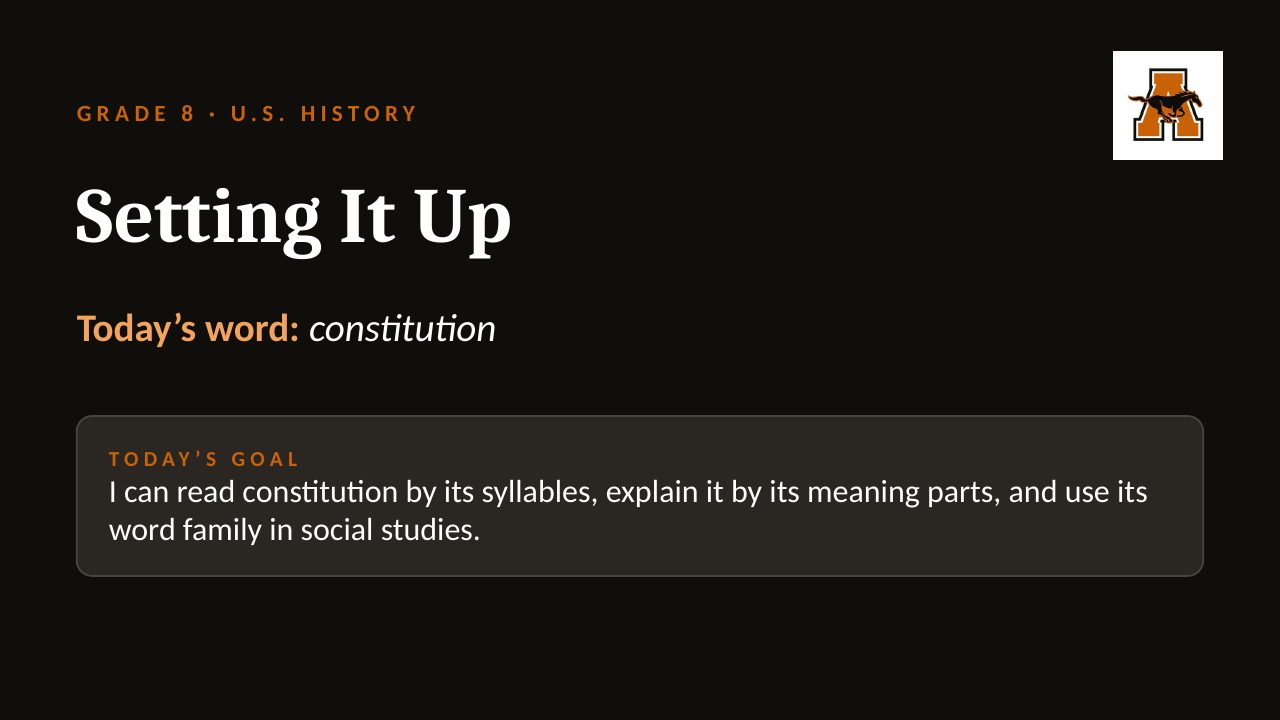
Setting It Up: teaching constitution
Coaching Kit
Manual, slide decks, e-book, and the coaching cycle
My specialty
Dyslexia & structured literacy in Social Studies
Many students who struggle in Social Studies are struggling with the reading, not the history. As a trained dyslexia teacher, I build structured literacy into every Social Studies lesson, and as a coach I help teachers do the same, so students with dyslexia and other reading gaps can do the same grade-level thinking as their classmates.
- Words first. Unit vocabulary taught through word parts, so students can unlock new terms on their own.
- One routine, every grade. The same six steps in Grades 6, 7, and 8, so teachers can coach each other and students carry the strategy forward.
- Frames for evidence. Sentence frames for Claim, Evidence, and Reasoning, so every student can argue like a historian.
“It is not wrong to go back for what you forgot.”
Sankofa · West AfricaWhy I teach Social Studies
History has never felt distant to me.
My family ties to Liberia, West Africa, connect the very stories I teach. Liberia was founded in 1822 by free and formerly enslaved Black Americans, and its history runs straight through U.S. History, World History, and World Geography.
From 2019 to 2021, I lived in Liberia, caring for my mother full time and supporting community development work. I saw up close how land, climate, culture, and a nation’s past shape everyday life. When my students study world cultures or the history of Texas and the United States, they learn from a teacher who has lived that connection, and I use it to help every student see their own family’s story as part of history.
My work carries the name Sankofa, an Akan word and symbol that means “go back and get it.” It is the best reason I know to study history, and the best reason I know to coach: we look back at what worked, and carry it forward together.
My path
- 2025 – 2026Dyslexia Teacher · Alvin ISD
Structured literacy intervention for secondary students.
- 2022 – 2025Co-Teacher, Social Studies & ELA · Houston ISD
Inclusion classrooms; grade-level content for every reader.
- 2019 – 2021Liberia, West Africa
Full-time family care and community development work.
- 2013 – 2018Social Studies Teacher · Spring ISD
Five years of secondary Social Studies, planned from the TEKS.
Same Strategy, Every Grade · 45-Minute Lesson
Rule by the People:
Teaching democracy
Texas TEKS
6.10(A) Identify and give examples of governments with rule by one, few, or many. • 6.9(A) Describe and compare examples of limited and unlimited governments such as constitutional (limited) and totalitarian (unlimited).
Measurable Objectives (SWBAT)
Given democracy, students will split it into 4 syllables, name each syllable type, and read it aloud accurately. Students will mark the 2 morphemes in democracy and write a working definition from the parts. Students will build at least 4 words from the cracy family and use them to classify governments as rule by one, few, or many.
Who should hold the power in a society, and how do people limit it?
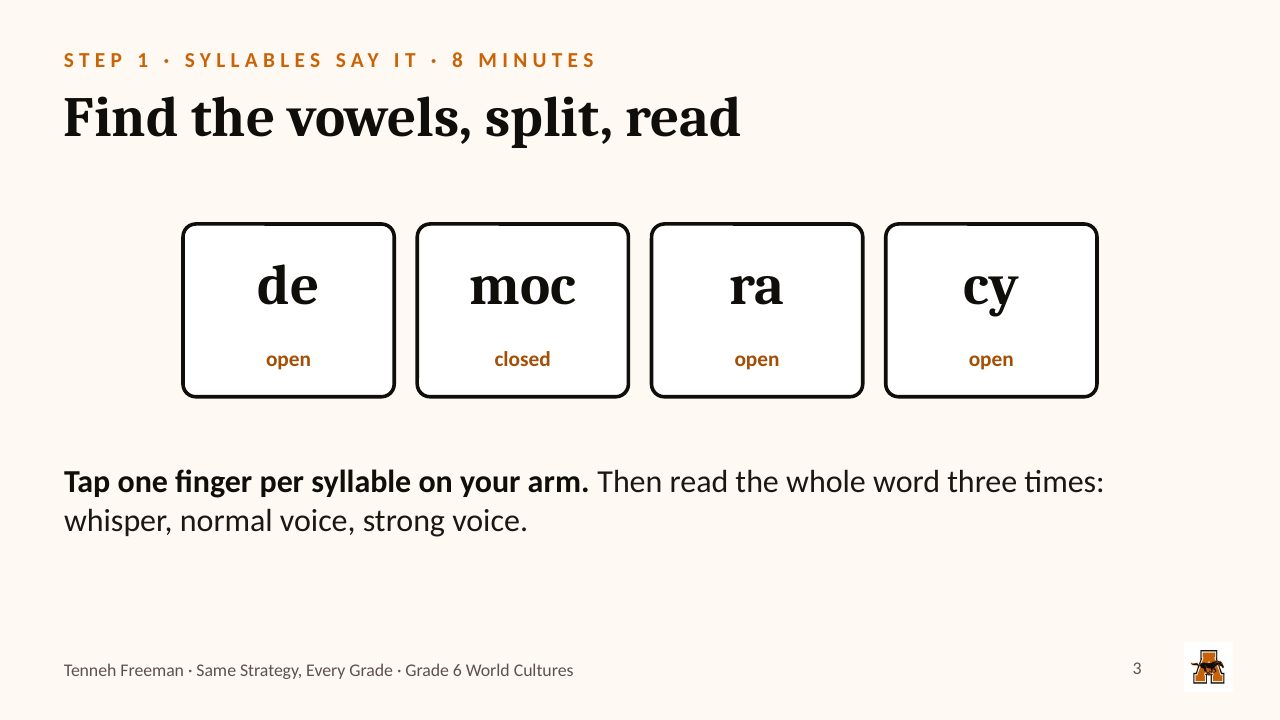
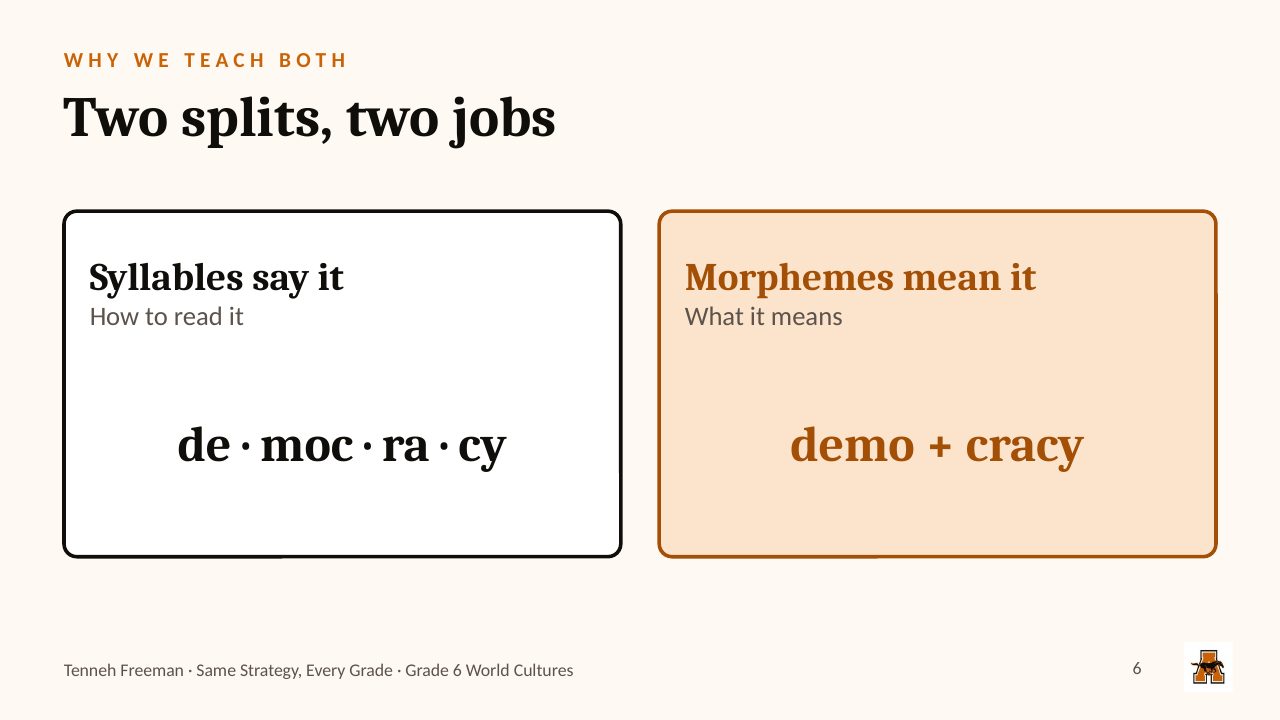
Syllables say it:
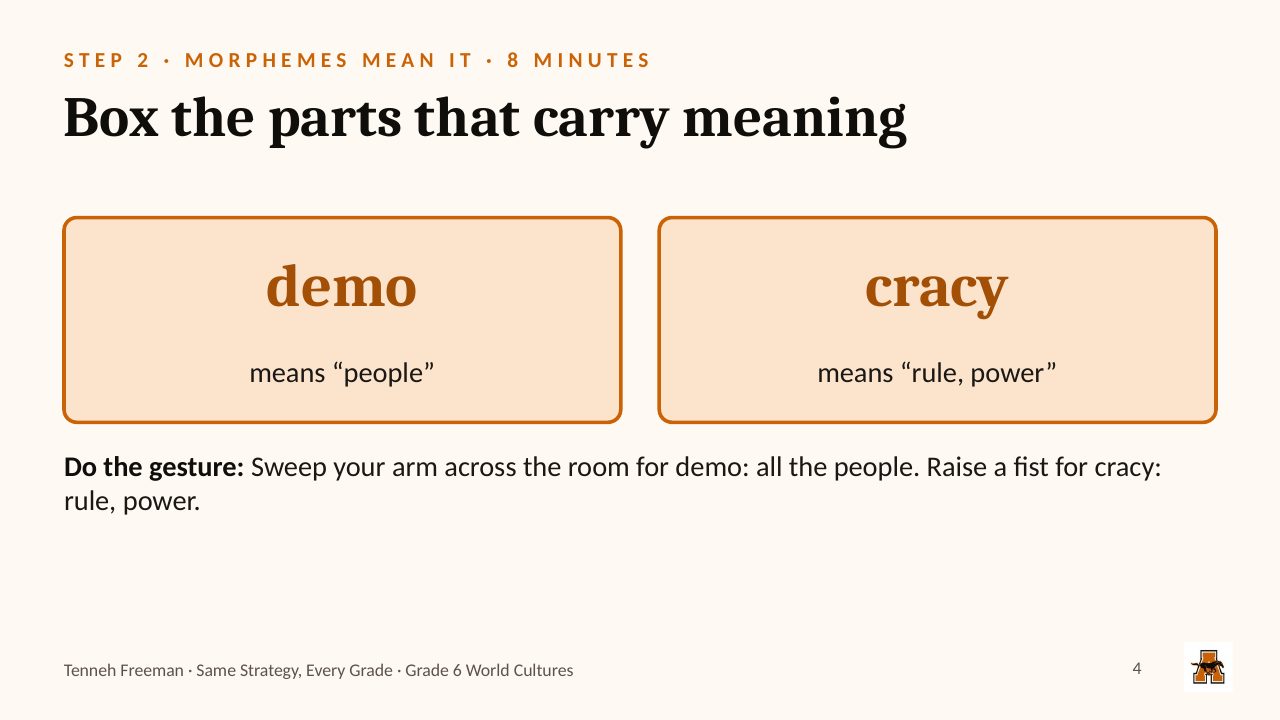
Morphemes mean it:
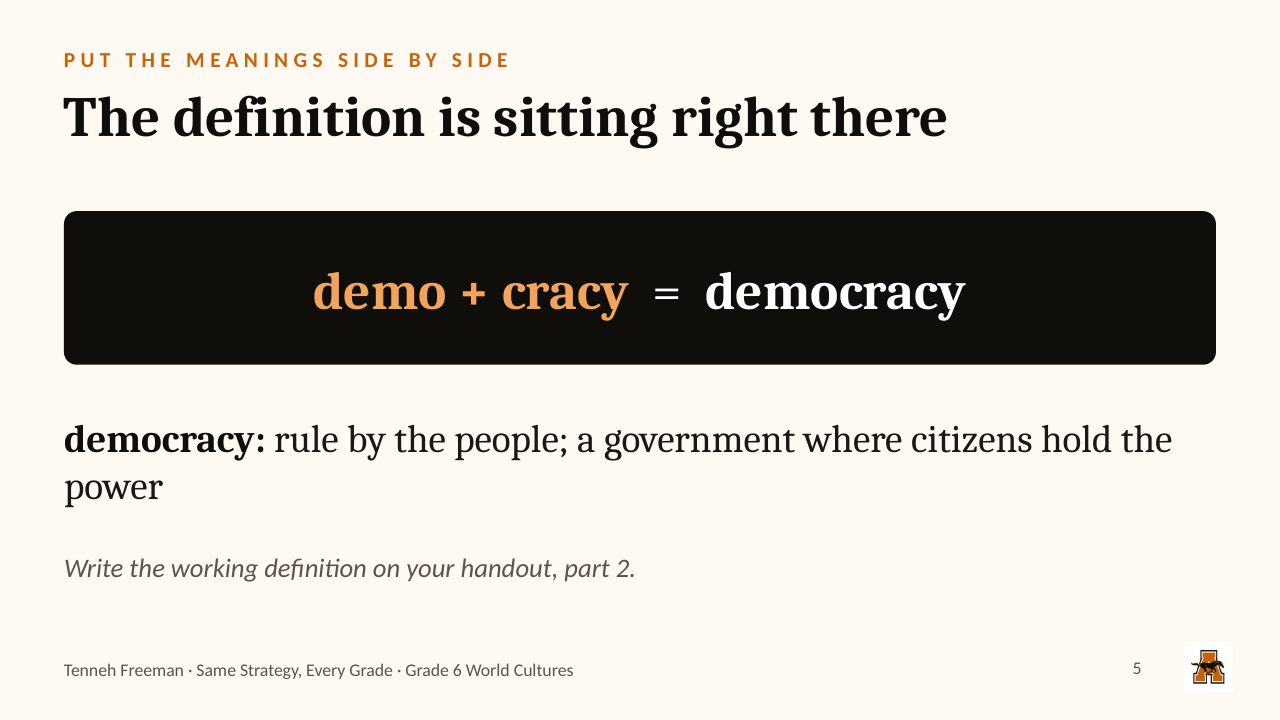
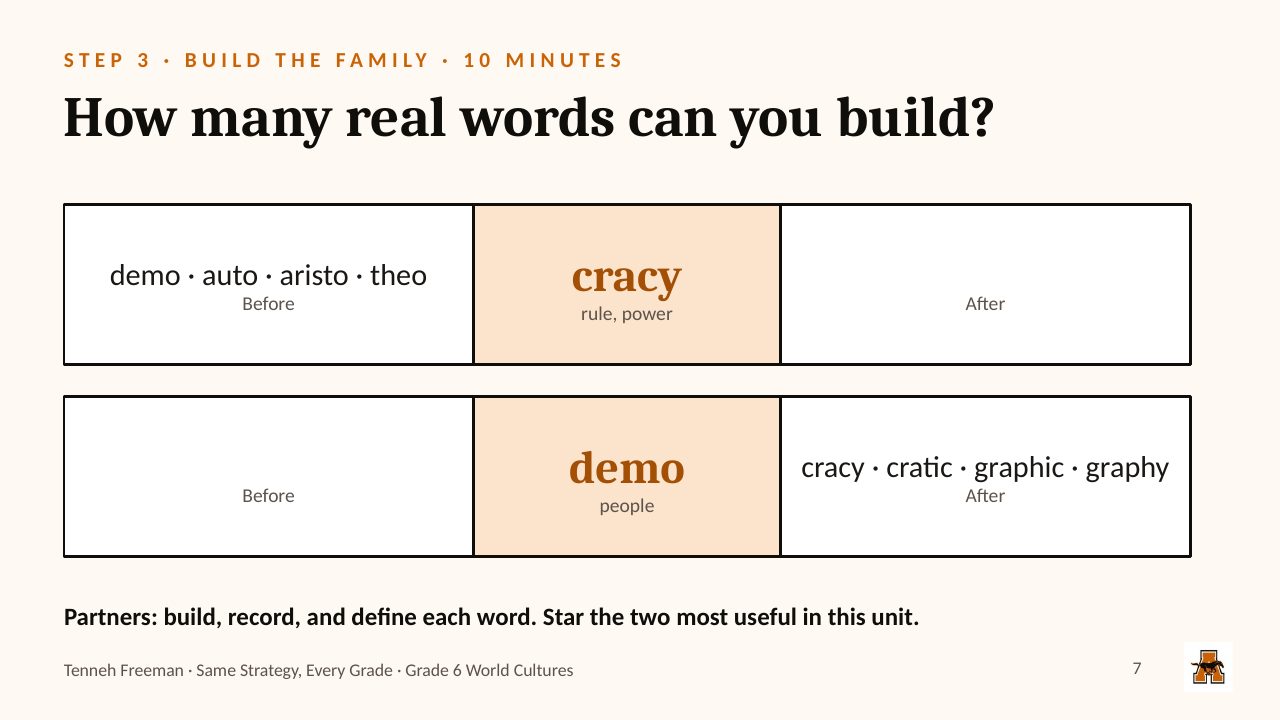
Democracy is two meaning parts: demo (people) and cracy (rule). Put them side by side: rule by the people. Change the first part and you change who rules.
- autocracy: rule by one person
- aristocracy: rule by a few powerful families
- theocracy: rule by religious leaders in the name of God
- democratic: having to do with democracy
- demographic: having to do with data about a population
Lesson Procedure · 45 Minutes
| Phase | Time | Activity | Teacher Move |
|---|---|---|---|
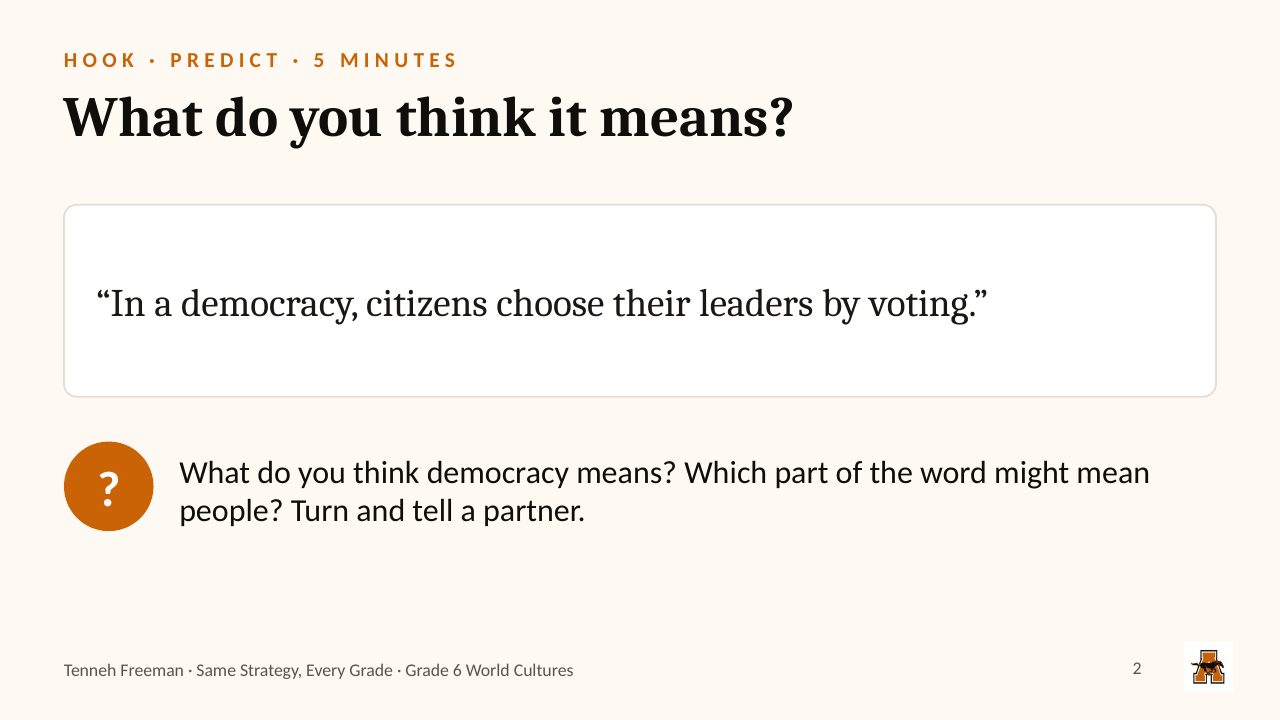
| Hook and Predict | 5 min | Read the sentence aloud once. Ask: “What do you think democracy means? Which part of the word might mean people?” Students predict before anyone reads it perfectly. | Chart predictions; return to them after the morphemes step. |
| Syllables Say It | 8 min | Mark the vowels, split the word, and name each syllable type. Students tap one finger per syllable and read it three times. | I do, we do, you do. Use the error correction script for any mis-split. |
| Morphemes Mean It | 8 min | Box the meaning parts and teach each one with its gesture. Put the meanings side by side: democracy = rule by the people; a government where citizens hold the power. | Ask: which part tells us who or what? Point out that the two splits do not line up. |
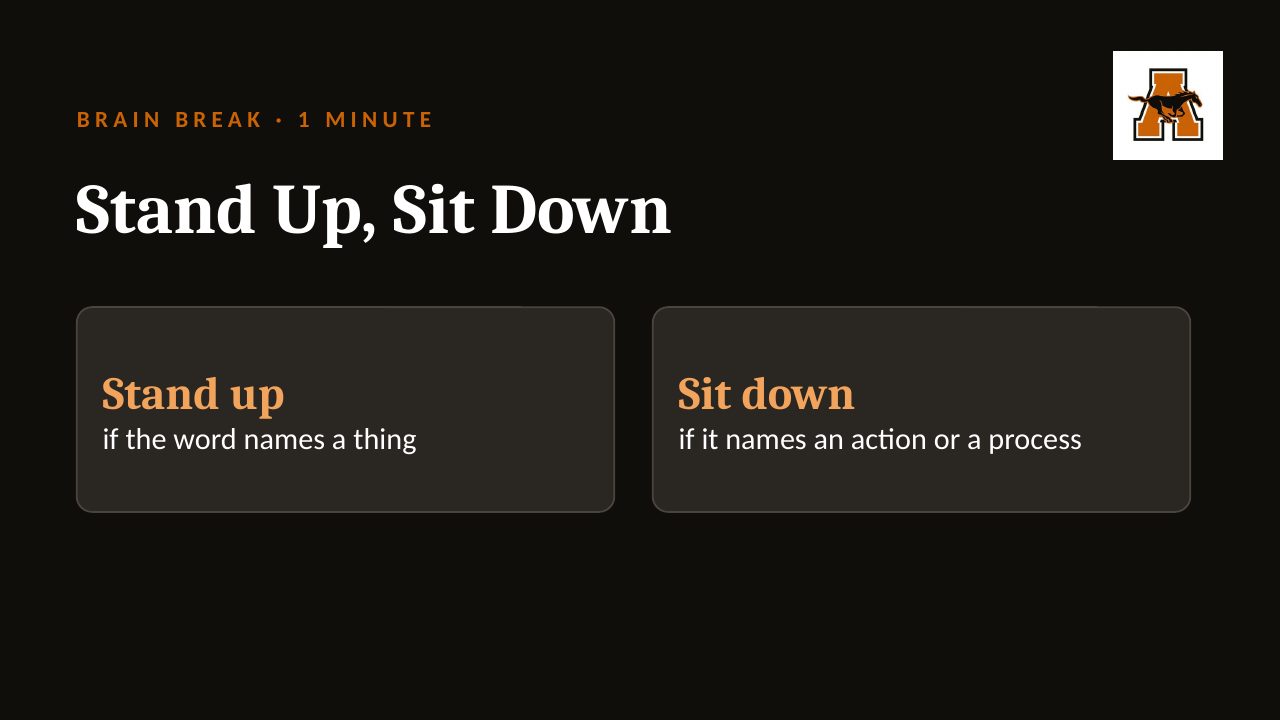
| Build the Family | 10 min | Partners build real words on the word matrix and say what each means. One-minute brain break at 0:30. | Check two words per pair; listen for meanings in students' own words. |
| Use It in Content | 10 min | Read “Who Holds the Power?.” Students highlight every family word, then answer three questions with evidence. | Push for evidence: “Where in the passage does it say that?” |
| Exit Ticket | 4 min | Students split autocracy, name its parts, and write what it means. Sort tickets into Got It, Almost, and Reteach. | Plan tomorrow's first five minutes from the Reteach pile. |
Differentiation
Scaffold
Word pre-split on a card; sentence frames for each question; passage read aloud first; oral answers accepted on the exit ticket. Spanish cognates: democracia, autocracia, aristocracia, teocracia, democrático, demográfico.
On Level
Full routine with partner word building, independent passage questions with evidence, and the written exit ticket.
Extend
Find meritocracy (rule by those with merit) and technocracy (rule by experts). Would either work for your school? Defend your answer.
Assessment
From the Sankofa Strategy Playlist
Teaching kit for this lesson
The Slides
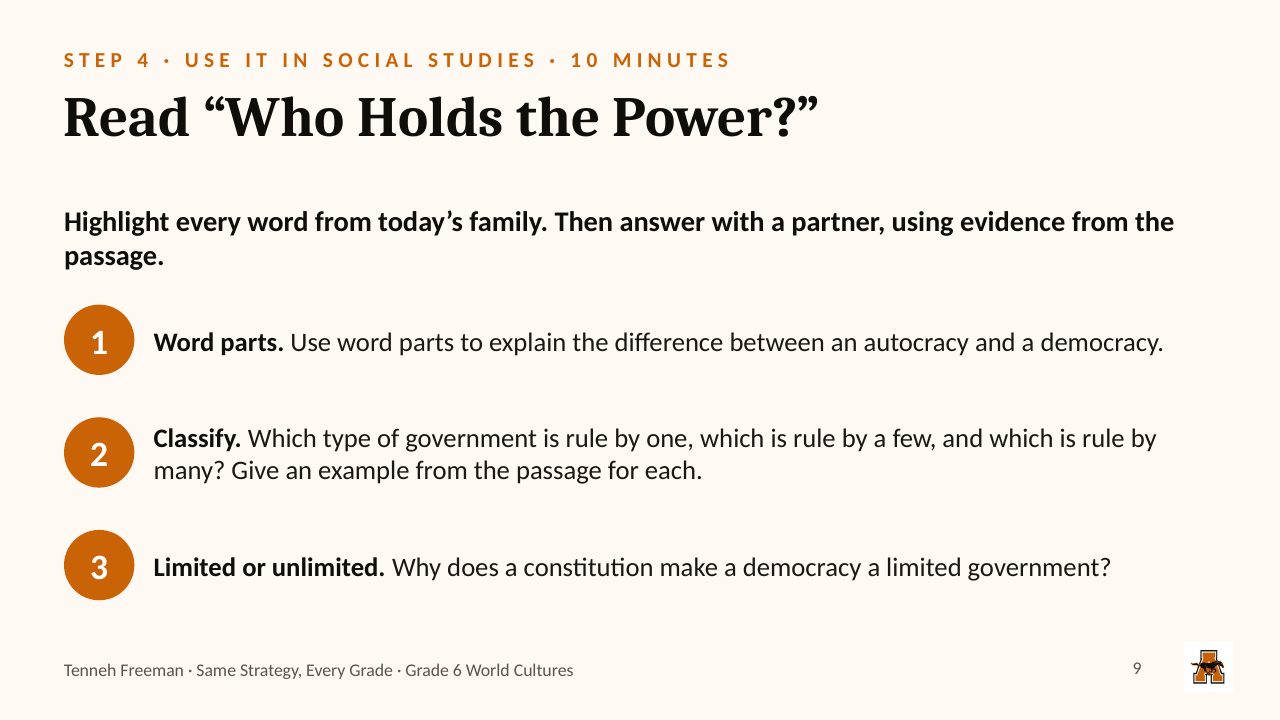
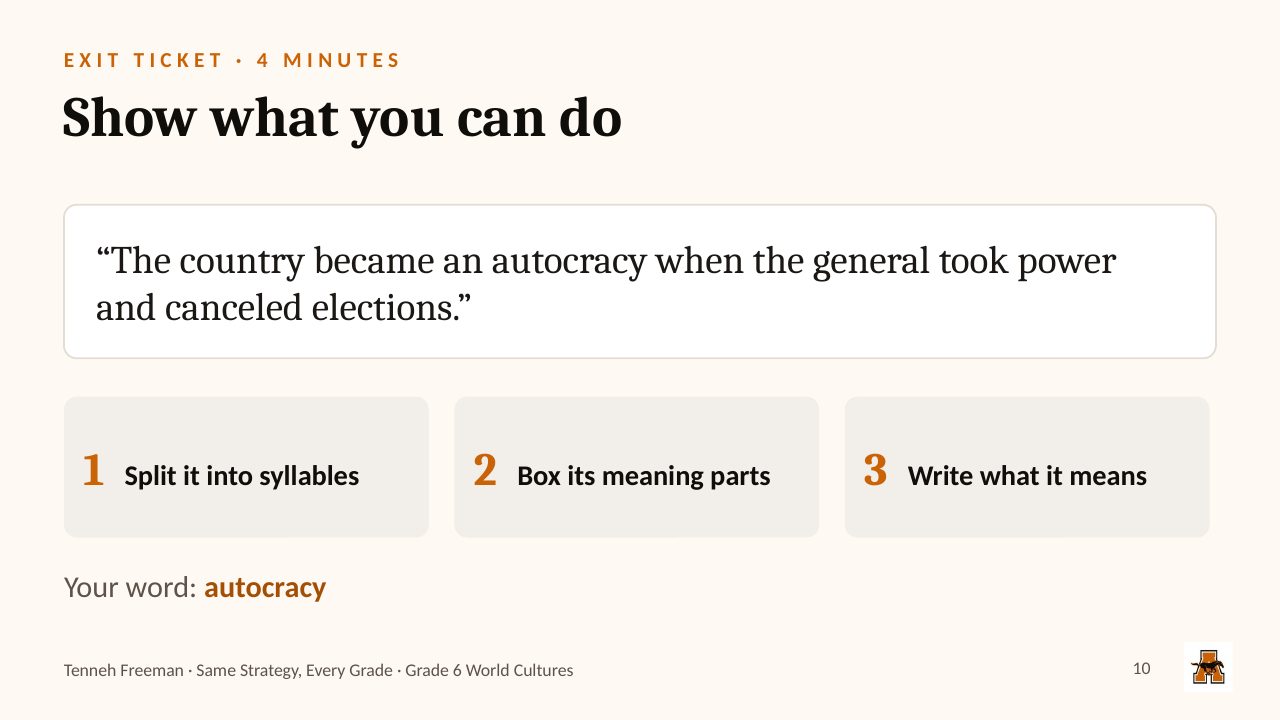
Same Strategy, Every Grade · 45-Minute Lesson
Tied to the Union:
Teaching annexation
Texas TEKS
7.4(B) Analyze the causes of and events leading to Texas annexation. • 7.1(B) Explain the significance of the following dates: … 1845, annexation.
Measurable Objectives (SWBAT)
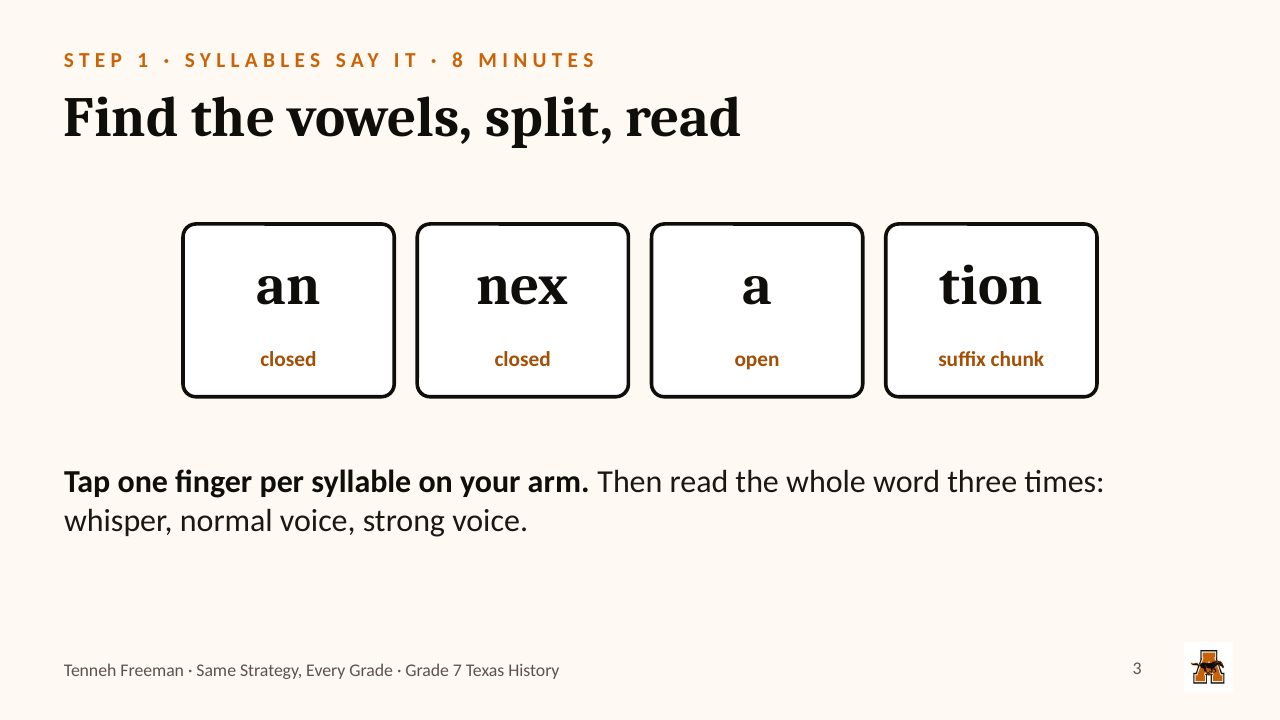
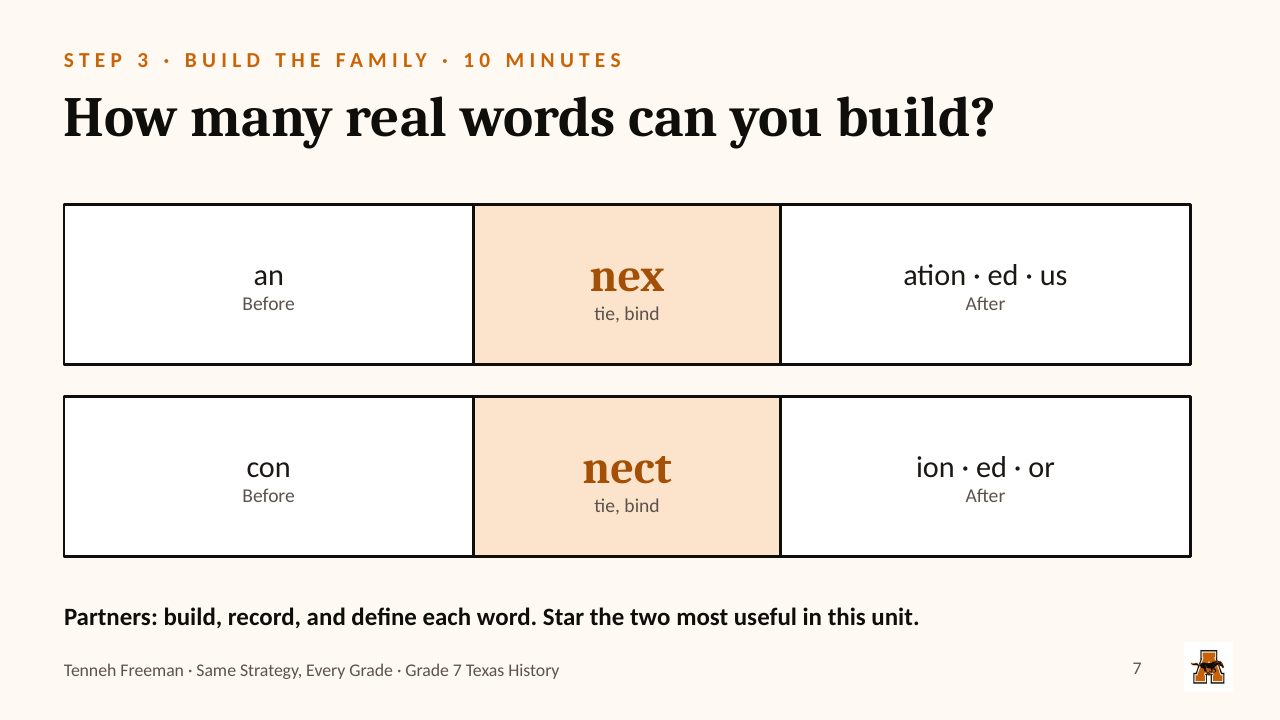
Given annexation, students will split it into 4 syllables, name each syllable type, and read it aloud accurately. Students will mark the 3 morphemes in annexation and write a working definition from the parts. Students will build at least 4 words from the nex/nect family and use them to explain the causes and effects of Texas annexation.
Why would an independent nation choose to give up its independence?
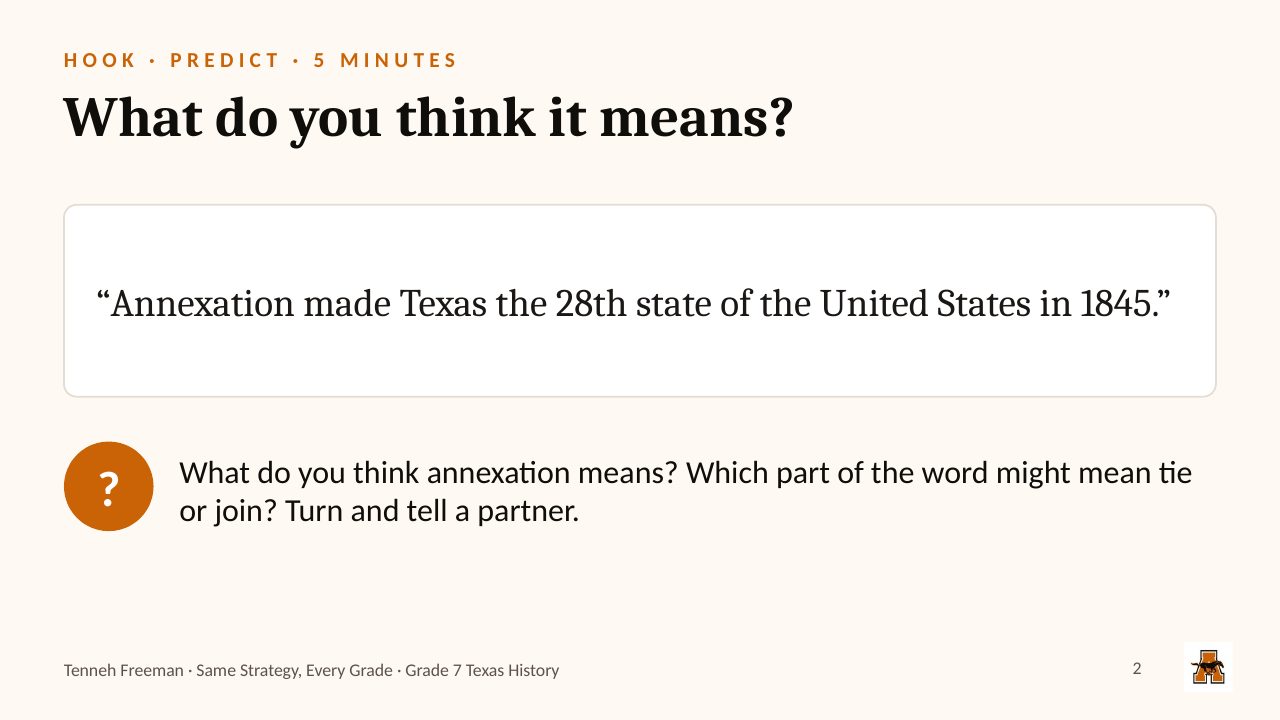
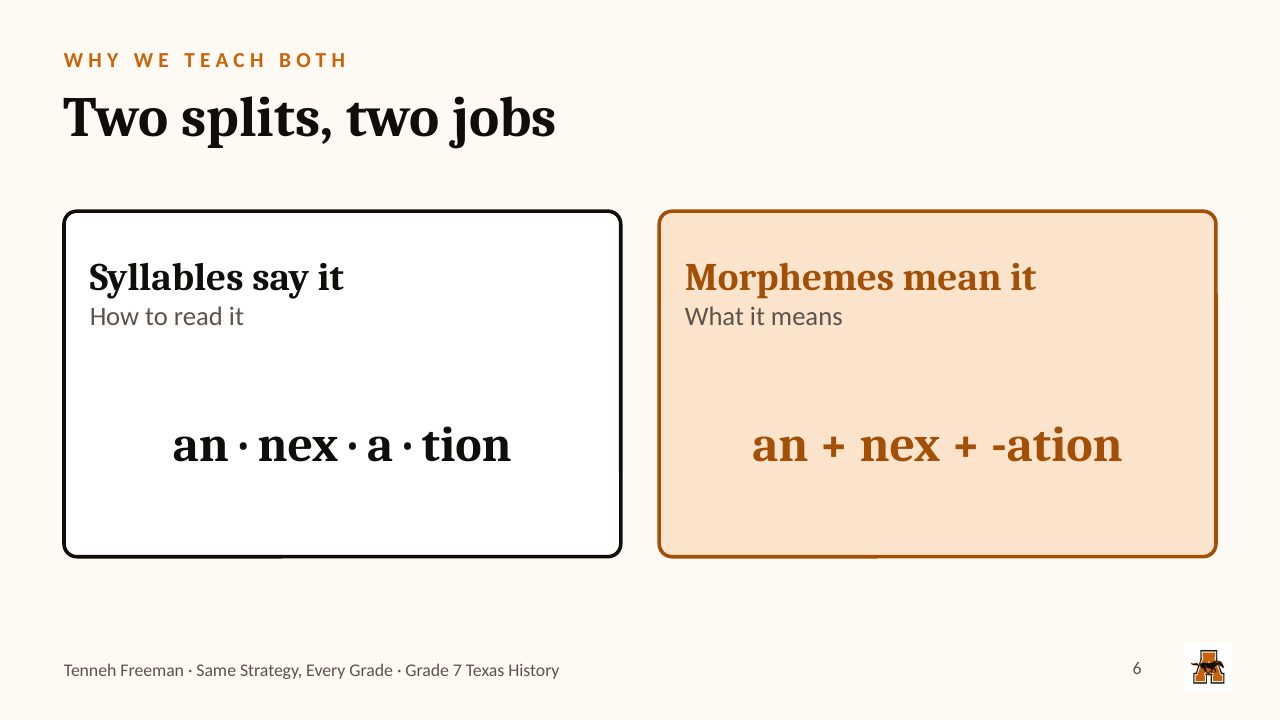
Syllables say it:
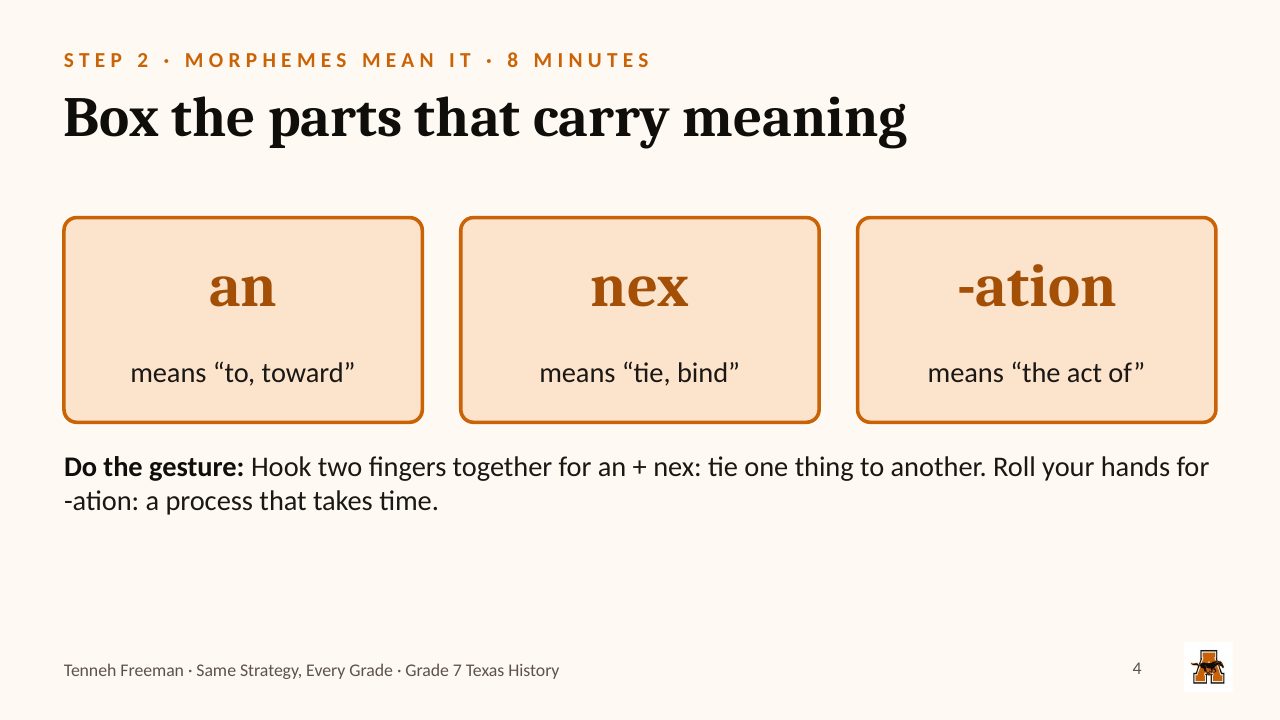
Morphemes mean it:
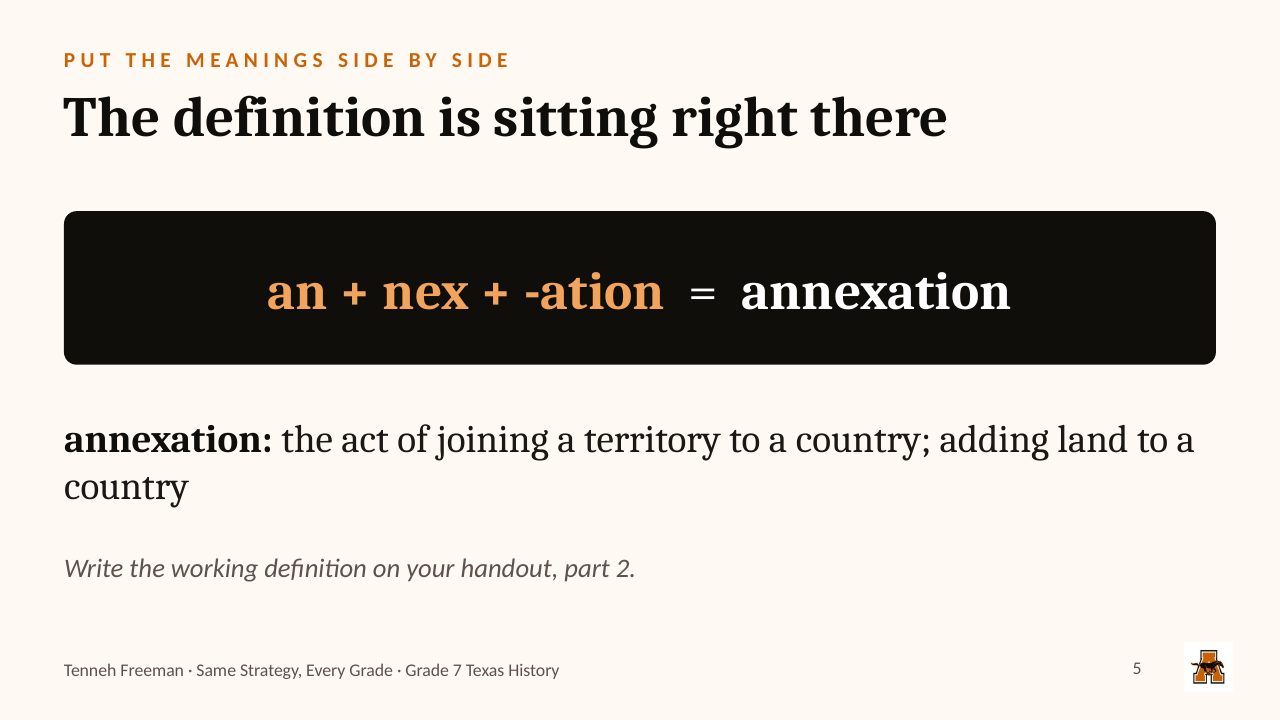
Annexation is three meaning parts: an (to), nex (tie, bind), and -ation (the act of). Together: the act of tying one thing to another. In 1845, Texas was tied to the United States.
- annex: to add on or tie on; also an added building
- annexed: added on; joined to
- connect: to tie together
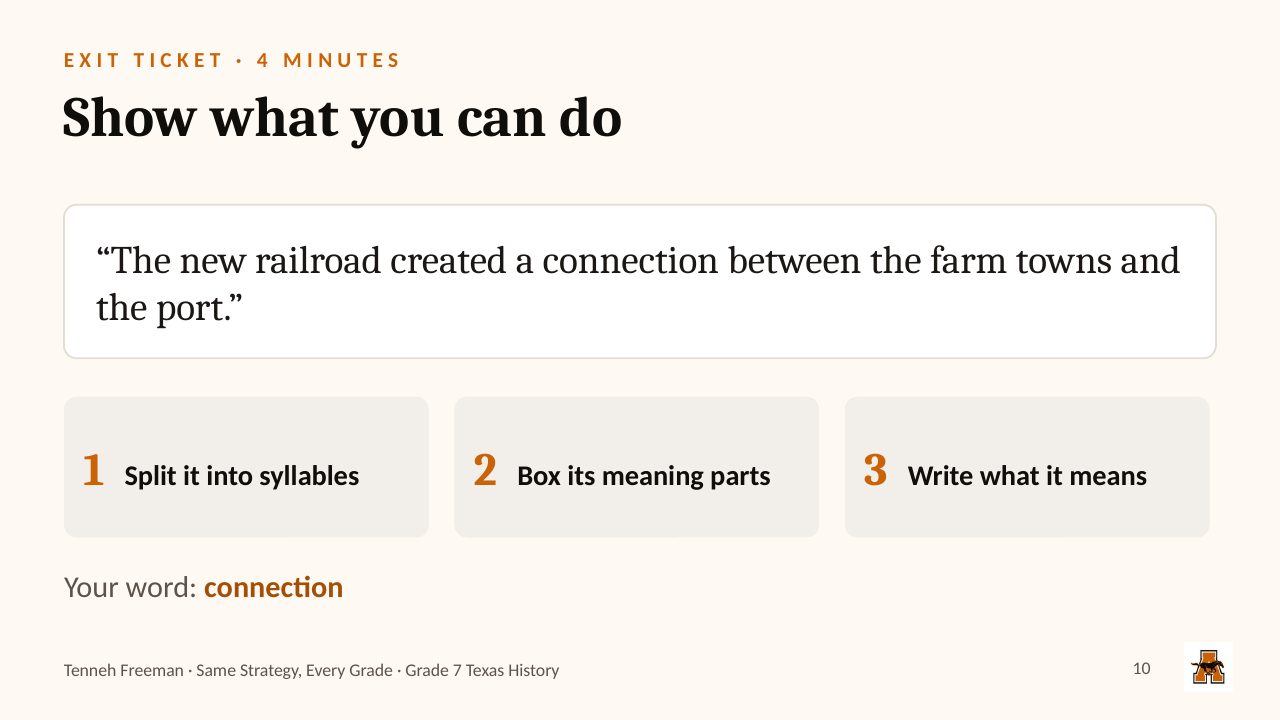
- connection: a link; the act of tying together
- nexus: a link or central connection
Lesson Procedure · 45 Minutes
| Phase | Time | Activity | Teacher Move |
|---|---|---|---|
| Hook and Predict | 5 min | Read the sentence aloud once. Ask: “What do you think annexation means? Which part of the word might mean tie or join?” Students predict before anyone reads it perfectly. | Chart predictions; return to them after the morphemes step. |
| Syllables Say It | 8 min | Mark the vowels, split the word, and name each syllable type. Students tap one finger per syllable and read it three times. | I do, we do, you do. Use the error correction script for any mis-split. |
| Morphemes Mean It | 8 min | Box the meaning parts and teach each one with its gesture. Put the meanings side by side: annexation = the act of joining a territory to a country; adding land to a country. | Ask: which part tells us who or what? Point out that the two splits do not line up. |
| Build the Family | 10 min | Partners build real words on the word matrix and say what each means. One-minute brain break at 0:30. | Check two words per pair; listen for meanings in students' own words. |
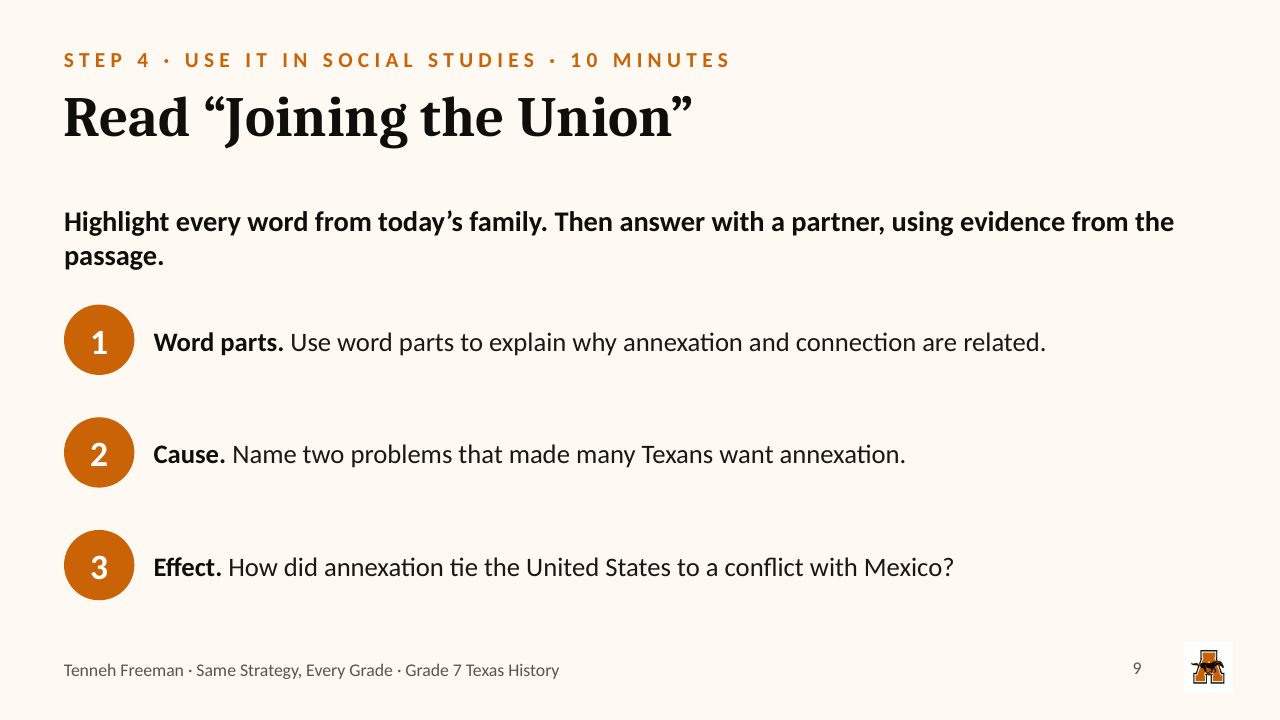
| Use It in Content | 10 min | Read “Joining the Union.” Students highlight every family word, then answer three questions with evidence. | Push for evidence: “Where in the passage does it say that?” |
| Exit Ticket | 4 min | Students split connection, name its parts, and write what it means. Sort tickets into Got It, Almost, and Reteach. | Plan tomorrow's first five minutes from the Reteach pile. |
Differentiation
Scaffold
Word pre-split on a card; sentence frames for each question; passage read aloud first; oral answers accepted on the exit ticket. Spanish cognates: anexión, anexar, conexión, conectar, nexo.
On Level
Full routine with partner word building, independent passage questions with evidence, and the written exit ticket.
Extend
Compare the annexation of Texas (1845) with the annexation of Hawaii (1898). What was tied to the United States, and who was left out of the decision?
Assessment
From the Sankofa Strategy Playlist
Teaching kit for this lesson
The Slides
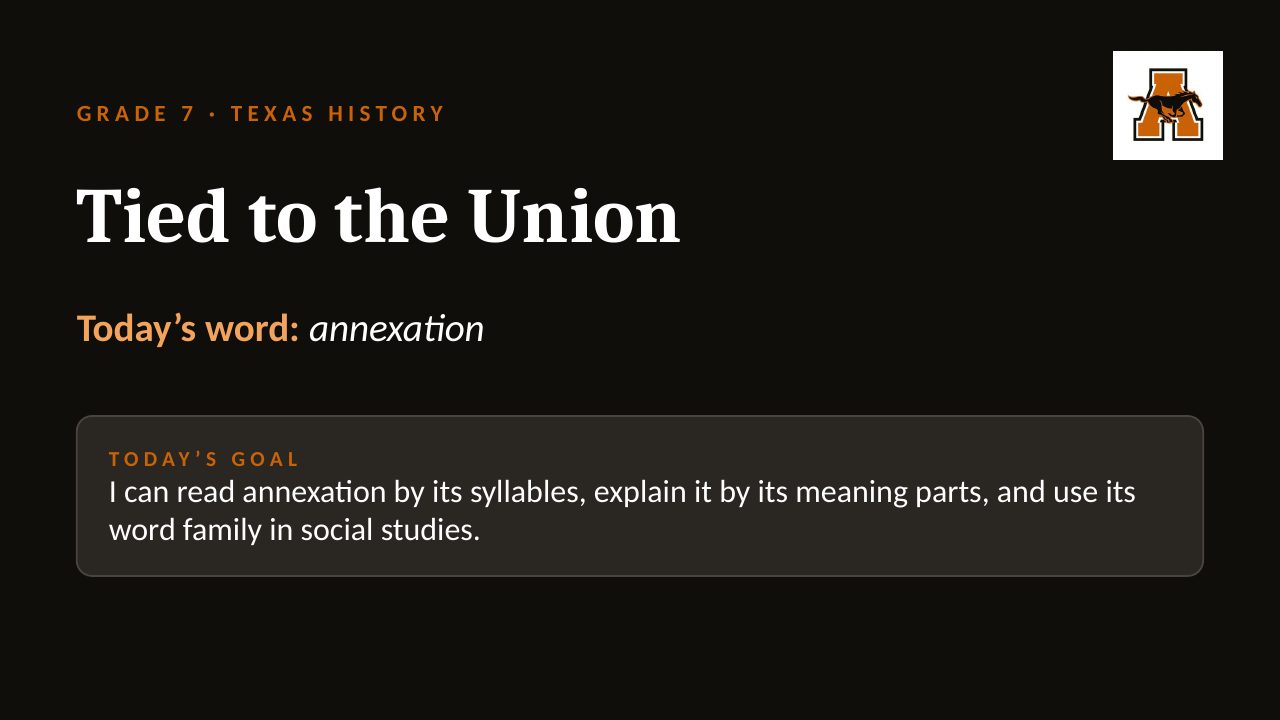
Same Strategy, Every Grade · 45-Minute Lesson
Setting It Up:
Teaching constitution
Texas TEKS
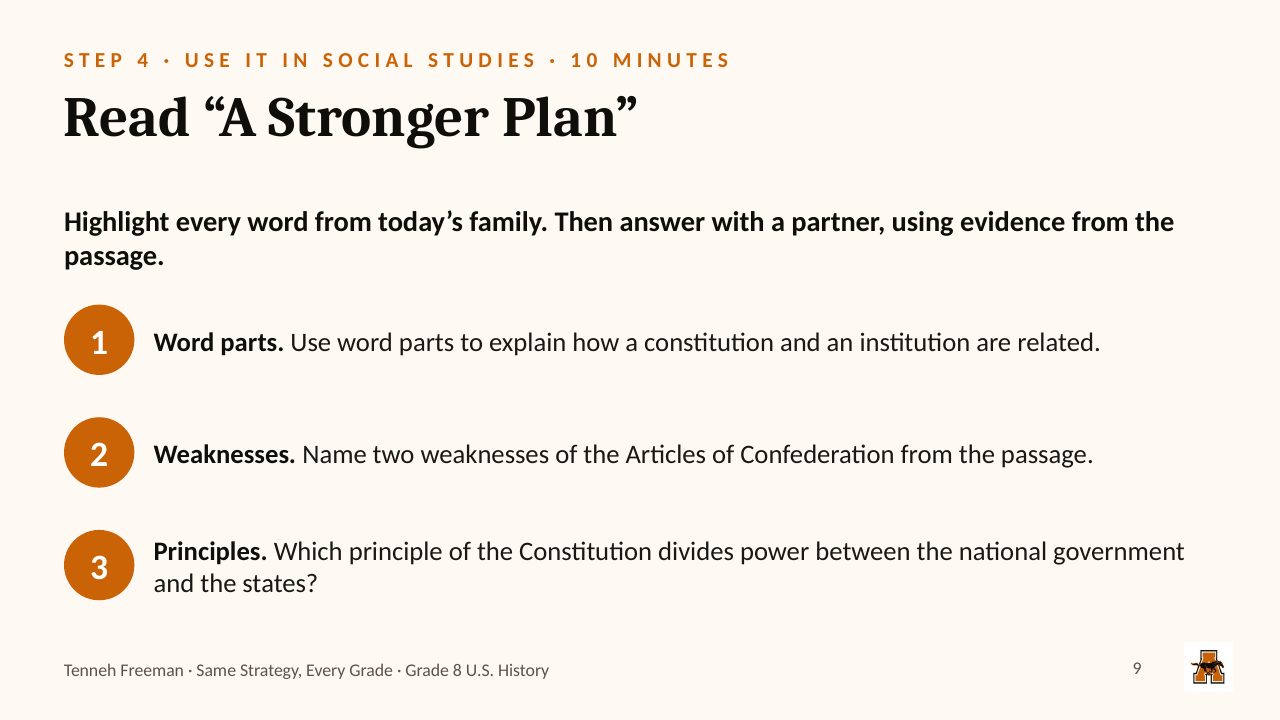
8.15(B) Summarize the strengths and weaknesses of the Articles of Confederation. • 8.15(D) Analyze how the U.S. Constitution reflects the principles of limited government, republicanism, checks and balances, federalism, separation of powers, popular sovereignty, and individual rights.
Measurable Objectives (SWBAT)
Given constitution, students will split it into 4 syllables, name each syllable type, and read it aloud accurately. Students will mark the 3 morphemes in constitution and write a working definition from the parts. Students will build at least 4 words from the stitut family and use them to explain how the Constitution fixed weaknesses of the Articles of Confederation.
What makes a government strong enough to work but limited enough to protect freedom?
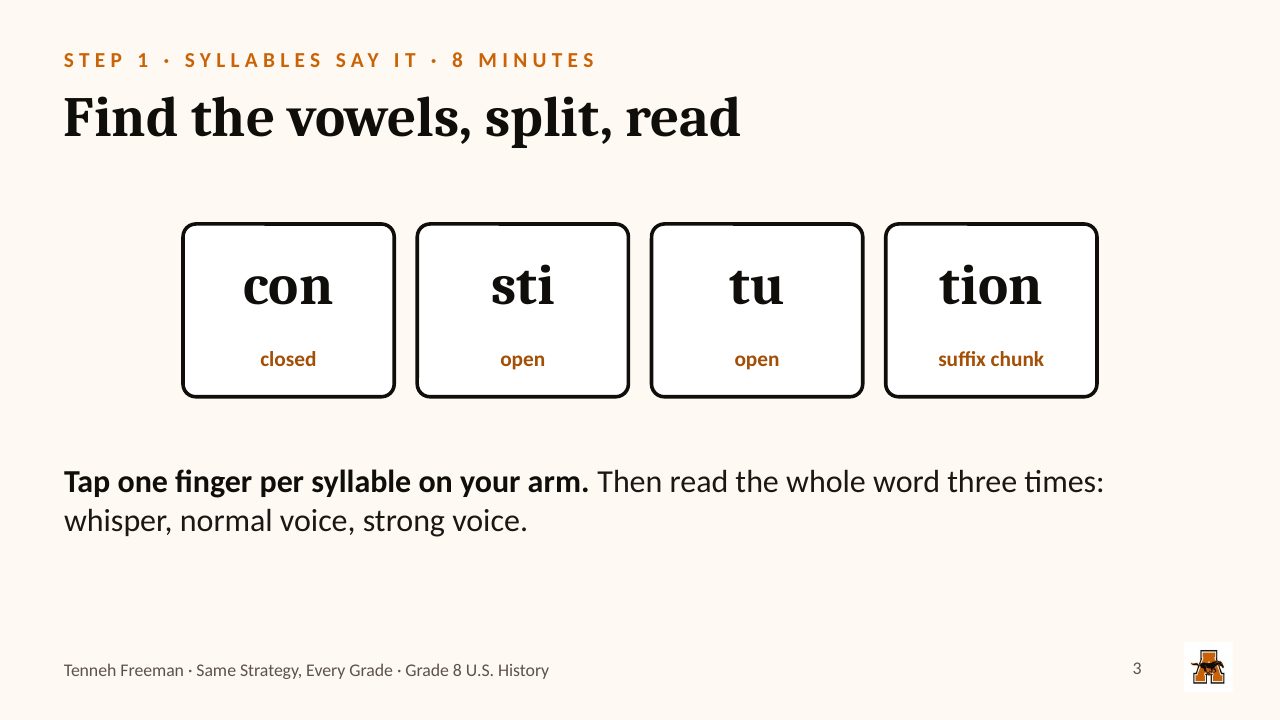
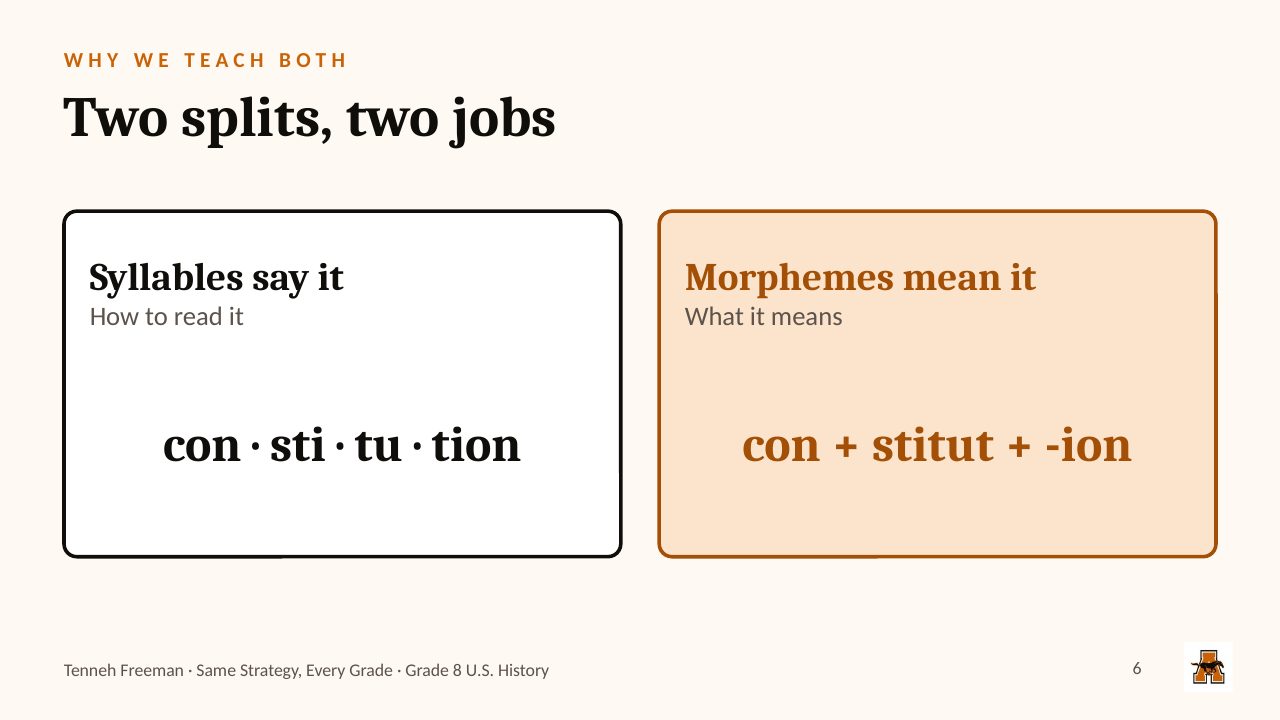
Syllables say it:
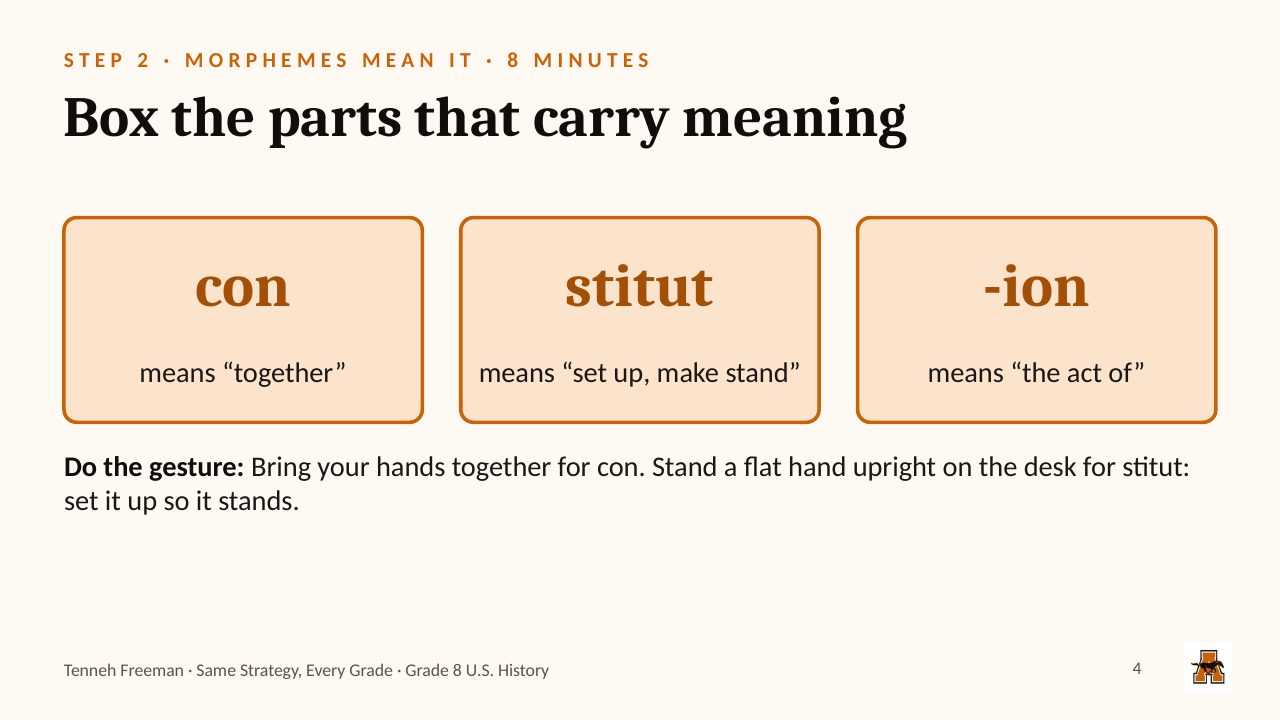
Morphemes mean it:
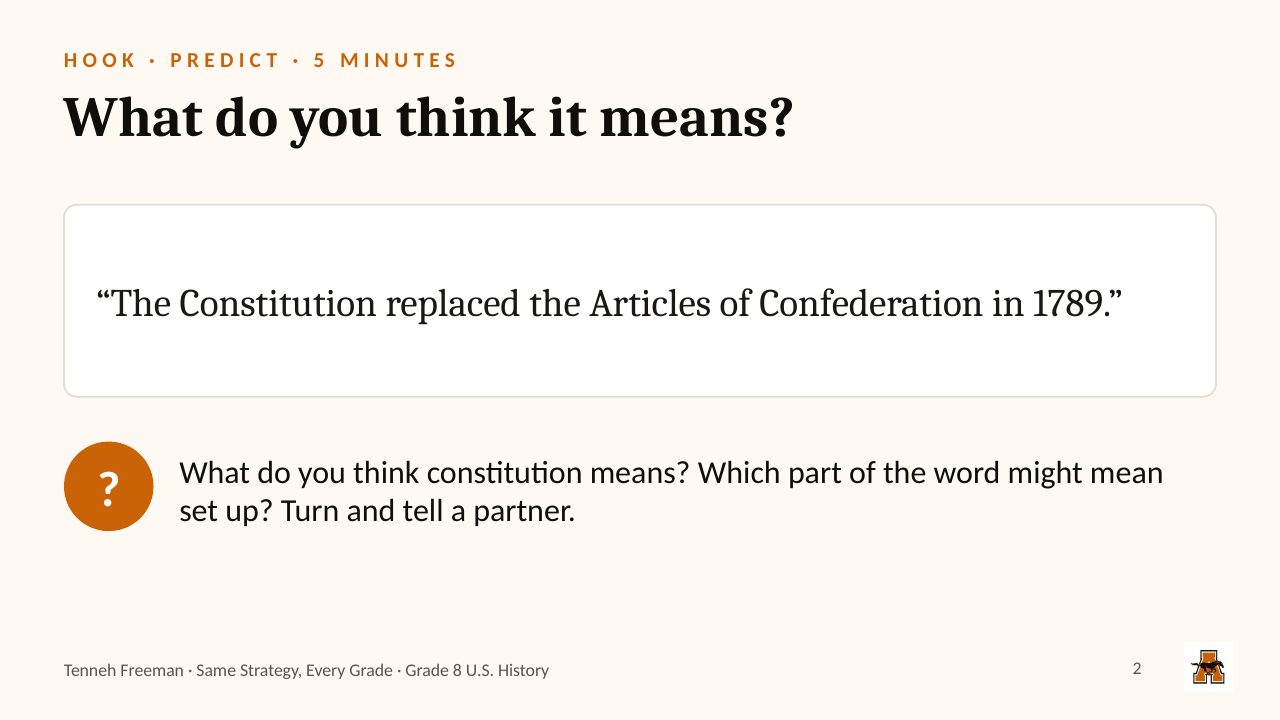
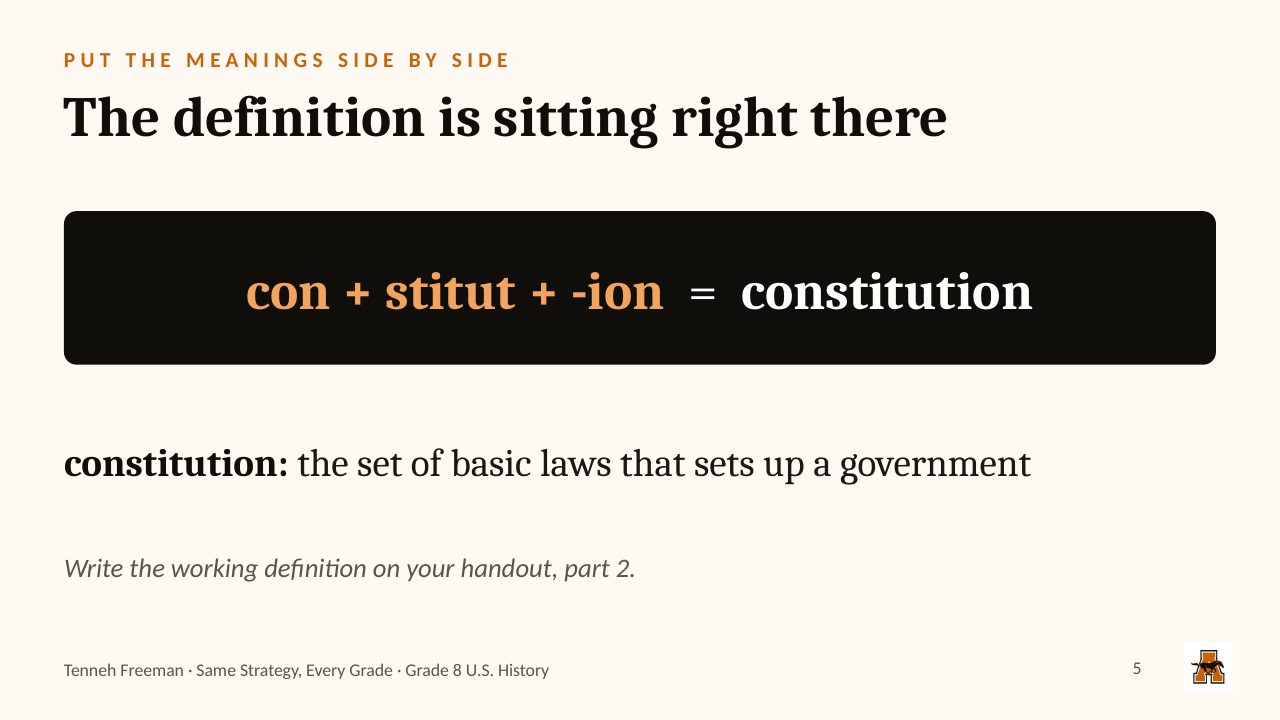
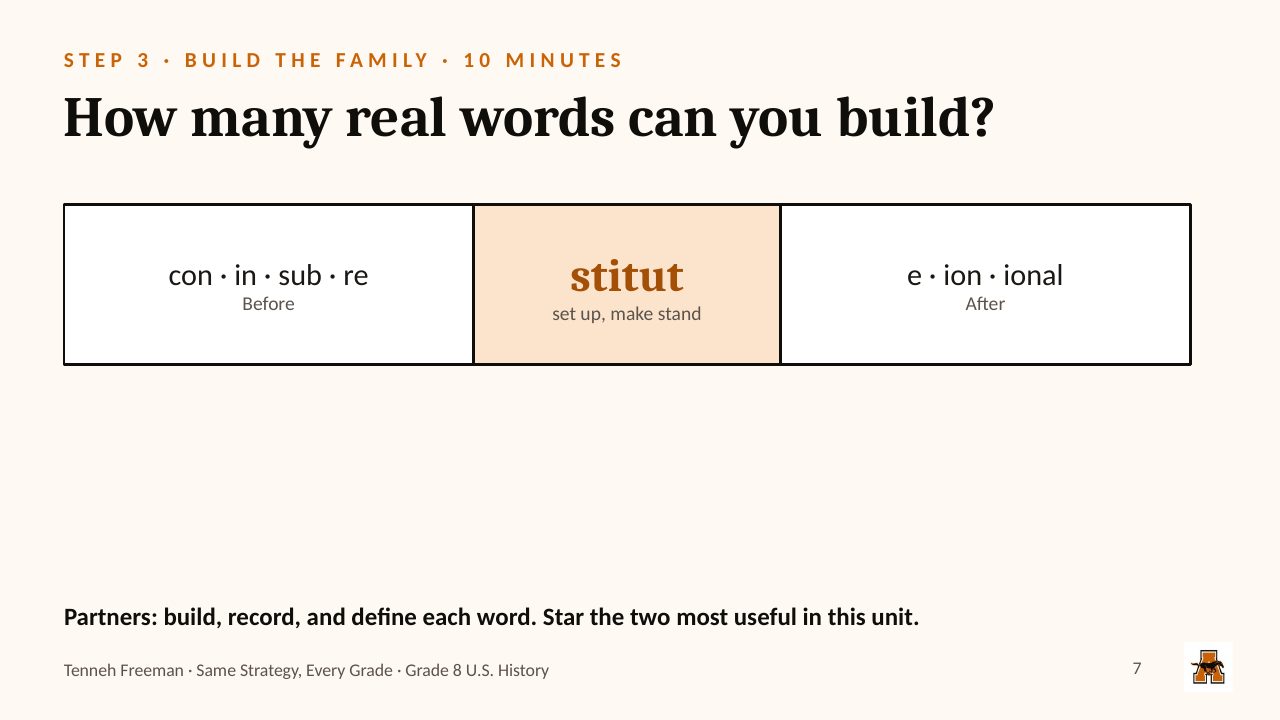
Constitution is three meaning parts: con (together), stitut (set up, make stand), and -ion (the act of). Together: the act of setting something up together. The U.S. Constitution set up a new government.
- constitute: to set up or make up
- constitutional: allowed by or having to do with a constitution
- institution: something set up to last, like a court or a school
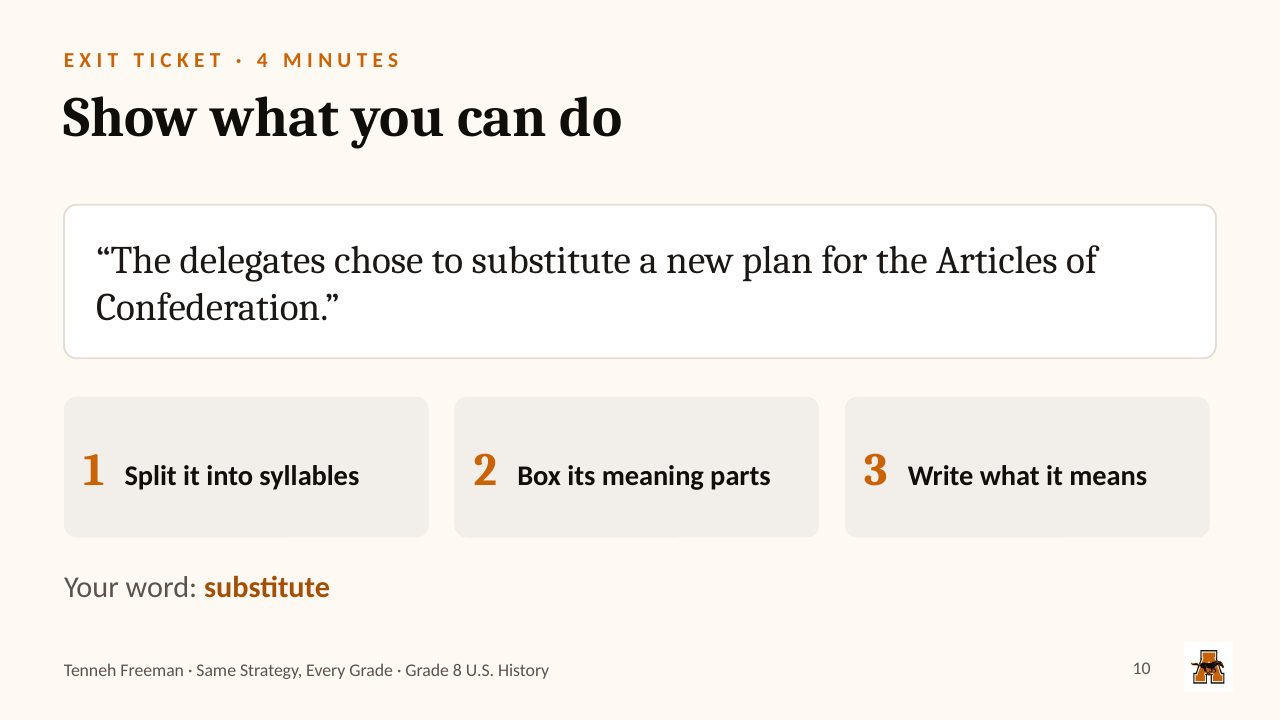
- substitute: to set in place of something else
- restitution: setting things right again; paying back
Lesson Procedure · 45 Minutes
| Phase | Time | Activity | Teacher Move |
|---|---|---|---|
| Hook and Predict | 5 min | Read the sentence aloud once. Ask: “What do you think constitution means? Which part of the word might mean set up?” Students predict before anyone reads it perfectly. | Chart predictions; return to them after the morphemes step. |
| Syllables Say It | 8 min | Mark the vowels, split the word, and name each syllable type. Students tap one finger per syllable and read it three times. | I do, we do, you do. Use the error correction script for any mis-split. |
| Morphemes Mean It | 8 min | Box the meaning parts and teach each one with its gesture. Put the meanings side by side: constitution = the set of basic laws that sets up a government. | Ask: which part tells us who or what? Point out that the two splits do not line up. |
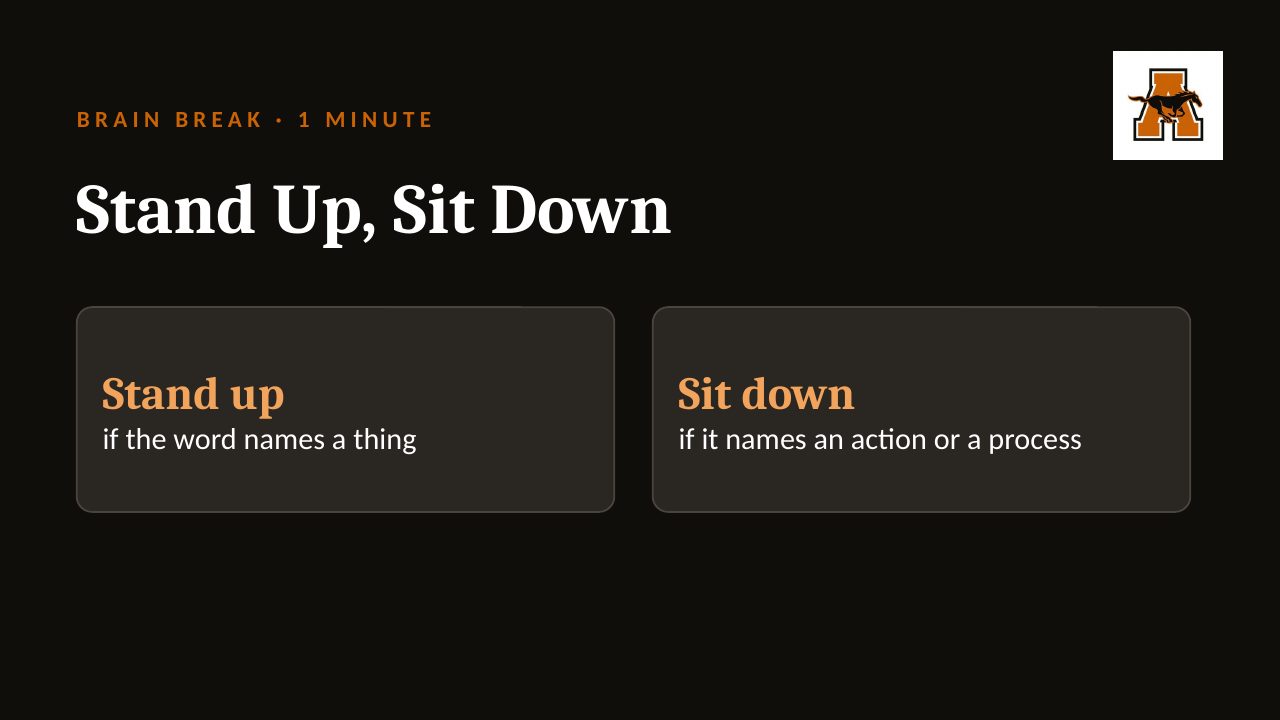
| Build the Family | 10 min | Partners build real words on the word matrix and say what each means. One-minute brain break at 0:30. | Check two words per pair; listen for meanings in students' own words. |
| Use It in Content | 10 min | Read “A Stronger Plan.” Students highlight every family word, then answer three questions with evidence. | Push for evidence: “Where in the passage does it say that?” |
| Exit Ticket | 4 min | Students split substitute, name its parts, and write what it means. Sort tickets into Got It, Almost, and Reteach. | Plan tomorrow's first five minutes from the Reteach pile. |
Differentiation
Scaffold
Word pre-split on a card; sentence frames for each question; passage read aloud first; oral answers accepted on the exit ticket. Spanish cognates: constitución, constituir, constitucional, institución, sustituir, restitución.
On Level
Full routine with partner word building, independent passage questions with evidence, and the written exit ticket.
Extend
Read the Preamble. Find the words that tell what “We the People” do (“do ordain and establish”). How does establish connect to the meaning of constitution?
Assessment
From the Sankofa Strategy Playlist
Teaching kit for this lesson
The Slides
Plan with Alvin ISD
Pacing and
Instructional Calendar
Every lesson, project, and PLC plan in this portfolio follows the district's Year at a Glance for each course. The orange tags show where each Same Strategy lesson fits, and the shaded grading periods are the spring semester.
Year at a Glance by course
Grade 6 · World Cultures
Alvin ISD Year at a Glance, revised August 2026
- Unit 1: Intro to Geography
- Unit 2: North America (Canada, the U.S. and Mexico)
- Unit 3: Central America, the Caribbean and South America
- Unit 3: Central America, the Caribbean and South America (continued)
- Unit 4: Europe, Russia and the Eurasian Republics
- Unit 5: Sub-Saharan Africa
- Unit 5: Sub-Saharan Africa (continued)
- Unit 6: Southwest Asia and North Africa
- Unit 7: South Asia
- Unit 8: East Asia Lesson: Who holds the power? (democracy)
- Unit 8: East Asia (continued)
- Unit 9: Southeast Asia
- Unit 10: Australia, the Pacific Realm and Antarctica
Grade 7 · Texas History
Alvin ISD Year at a Glance, revised July 2026
- Unit 1: Natural Texas and Its People
- Unit 2: Exploration and Colonization
- Unit 3: Mexican National Era
- Unit 4: Road to Texas Revolution
- Unit 4: Road to Texas Revolution (continued)
- Unit 5: Republic of Texas and Early Statehood Lesson: Annexation
- Unit 6: Civil War and Reconstruction
- Unit 6: Civil War and Reconstruction (continued)
- Unit 7: The Texas Frontier
- Unit 8: Cotton, Cattle, and Railroads
- Unit 8: Cotton, Cattle, and Railroads (continued)
- Unit 9: Age of Oil
- Unit 10: World War I, the Great Depression and World War II
- Unit 11: Contemporary Texas
- Unit 12: Texas Government
Grade 8 · U.S. History
Alvin ISD Year at a Glance, revised July 2026
- Unit 1: Exploration and European Colonization of North America
- Unit 2: The Revolutionary Era
- Unit 3: Articles of Confederation, Constitution, and Citizenship Lesson: Constitution
- Unit 4: Early Republic
- Unit 5: The Age of Jackson and Westward Expansion
- Unit 6: Industrialization, Reform and Culture
- Unit 7: Sectionalism and the Civil War
- Unit 8: The Reconstruction Era
- Unit 9: Geographer's Toolbox
2026–27 instructional calendar
| Date | What happens |
|---|---|
| Aug 12 | Transition day: Grade 6 (and Pre-K, K, Grade 9) students start |
| Aug 13 | All other students start · Grading Period 1 begins |
| Sep 7 | Labor Day holiday |
| Oct 9 | Grading Period 1 ends |
| Oct 12–16 | Fall break |
| Oct 19 | Grading Period 2 begins |
| Nov 23–27 | Thanksgiving week (no classes for students) |
| Dec 18 | Early dismissal · Grading Period 2 and first semester end |
| Dec 21–Jan 4 | Winter break |
| Jan 5 | District professional learning (no students) |
| Jan 6 | Students return · Grading Period 3 begins |
| Jan 18 | MLK Jr. Day holiday |
| Feb 12 | District professional learning (no students) |
| Feb 15 | Presidents' Day holiday |
| Mar 5 | Grading Period 3 ends |
| Mar 8–12 | Spring break |
| Mar 15 | Grading Period 4 begins |
| Mar 26–29 | Holiday |
| Apr 13–23 | STAAR Grade 8 Social Studies window |
| May 27 | Last day of school, early dismissal · Grading Period 4 ends |
Dates from the Alvin ISD 2026–27 academic calendar. Open the official district calendar (PDF) to confirm any date.
Enrichment · Grades 6–8
Project-Based Learning
and Field Trips
Each project starts with a driving question, ends with a product students share with a real audience, and reuses the vocabulary routine: every project lists a word family students build along the way. Pick one per unit, or use them after STAAR when 8th graders still have weeks of learning left.
Grade 6 · World Cultures
Market Day: How Economies Decide
How do different economic systems decide what gets made and who gets it?
Students run three short class markets under traditional, command, and free enterprise rules, track who got what, then write a data-based reflection.
Design a Nation
What kind of government would best serve a brand-new island nation?
Teams choose rule by one, few, or many, decide how power is limited, write a one-page constitution, and defend it at a mock world summit. Builds directly on the democracy lesson.
Culture Museum Gallery
How do people express who they are through culture?
Each group curates five artifacts (images or replicas) from one region, writes museum placards, and leads a gallery walk for another class.
Why People Move: A Story Map
What pushes people to leave a place, and what pulls them to a new one?
Students trace one migration story (a case study or, with permission, a family story) on Google Earth, tagging push and pull factors at each stop.
Water for Everyone
How do people adapt to and change their environment to get water?
Students compare water access in two regions, then pitch a realistic solution to a panel using maps, graphs, and one primary source.
Grade 7 · Texas History
Texas History Museum in a Box
What objects tell the story of a Texas era best?
Each team curates five artifacts for an assigned era, writes captions with dates and causes, and packs a traveling exhibit for a younger grade.
The Annexation Town Hall
Should the Republic of Texas join the United States?
Students take roles from 1844 and 1845 (Texans, U.S. senators, Mexican officials, enslaved and Tejano perspectives) and argue with evidence at a town hall. Builds on the annexation lesson.
Voices of Texas Podcast
Whose stories are missing from the Texas history we usually hear?
Pairs research a Texan from an underrepresented group using primary sources from the Portal to Texas History, then record a three-minute podcast episode.
Mark This Place
What local place in Brazoria County deserves to be remembered, and why?
Students research a nearby historic site, draft historical marker text, and present it to the class with a map and two sources.
Boom! The Texas Economy in Data
How did cotton, cattle, and oil change Texas?
Teams build a data story (infographic or slides) comparing the cotton, cattle, and oil booms, including the 1901 Spindletop gusher, and explain one effect on daily life.
Grade 8 · U.S. History
Constitutional Convention Simulation
How did delegates with opposite interests agree on one government?
Students represent states, debate representation and power, and reach their own compromise, then compare it with the Great Compromise. Builds on the constitution lesson.
Bill of Rights Case Files
Which right protects this person, and how far does it reach?
Teams argue short scenario cases in a mock court, citing the amendment that applies and one primary source.
Westward Journeys
Who gained and who lost as the United States expanded west?
Students write journal entries from several perspectives (settlers, American Indians, Tejanos, enslaved people) and build a Google Earth tour of the route.
Reform Movement Campaign
What made Americans of the 1800s push for change?
Teams design a campaign (speech, poster, and pamphlet) for abolition, women's rights, or education reform, using primary sources such as Frederick Douglass's speeches or the 1848 Seneca Falls Declaration.
What Freedom Meant: Reconstruction
What did freedom mean, and who decided?
Students create a short documentary or exhibit on the 13th, 14th, and 15th Amendments and Juneteenth, when Union troops announced freedom in Galveston on June 19, 1865.
Field trips for all grades
Sites within driving distance of Alvin, plus two Austin options for a longer trip. Grade fit shows where each site connects most directly to the TEKS. Confirm hours, fees, and booking rules on each site before planning.
| Site | Where | Best fit | What students experience |
|---|---|---|---|
| San Jacinto Battleground State Historic Site | La Porte | Grade 7, 8 | Where Texas won independence on April 21, 1836. Field trips run Wednesday through Friday, 10 a.m. to 4 p.m., and usually last two hours. |
| San Jacinto Museum of History | La Porte | Grade 7, 8 | Museum inside the San Jacinto Monument; school groups receive discounted admission. |
| Varner-Hogg Plantation State Historic Site | West Columbia (Brazoria County) | Grade 7, 8 | Stations on the families, enslaved and free, who built a Brazoria County plantation, and on Texas commerce and oil. |
| Levi Jordan Plantation State Historic Site | Brazoria | Grade 7, 8 | One of the best-preserved archeological sites tied to African American history in Texas. |
| Washington-on-the-Brazos State Historic Site | Washington | Grade 7, 8 | Where the Texas Declaration of Independence was signed on March 2, 1836. Standards-aligned school programs and outreach. |
| George Ranch Historical Park | Richmond | Grade 6, 7, 8 | Living history from the 1830s to the 1930s, including a program on the early Gulf Coast oil boom. Pre-booked groups Tuesday through Friday. |
| Holocaust Museum Houston | Houston (Museum District) | Grade 6, 7, 8 | Group tours for grades 6 to 12 on the Holocaust and human rights, in person or virtual. |
| Houston Museum of Natural Science | Houston (Hermann Park) or Sugar Land | Grade 6 | Exhibit halls including ancient Egypt; field trip packages are TEKS-aligned. |
| Texas Seaport Museum and 1877 Tall Ship Elissa | Galveston | Grade 6, 7, 8 | Immigration through Galveston, the “Ellis Island of the West,” with a searchable immigration database. Pairs with Juneteenth history in Galveston. |
| Buffalo Soldiers National Museum | Houston (Museum District) | Grade 7, 8 | African American military history. Closed for major renovations starting July 2025; check reopening before booking. |
| Bullock Texas State History Museum | Austin | Grade 7, 8 | The story of Texas from first peoples to today. Live virtual classes are available if travel is not possible. |
| Texas State Capitol | Austin | Grade 6, 7, 8 | Free guided tours on architecture, Texas history, and the legislative process, with grade-band teacher guides. Book early; spring fills fast. |
No time or budget for a bus? The Bullock Museum offers live virtual classes, and Holocaust Museum Houston offers virtual group experiences.
Instructional Coaching
Same Strategy, Every Grade:
A Coaching Kit for Grades 6–8
These lessons are built for teachers to use on their own, and for an instructional coach to use alongside them. Here is how I would use the kit with a Grades 6–8 Social Studies team. Every lesson uses the same routine, so a teacher who learns it in 6th grade can coach a colleague in 8th, and students carry one strategy from grade to grade.
A five-step coaching cycle
Look-fors during an observation
- The teacher splits the word into syllables before naming its meaning parts.
- Every student says the word aloud at least three times.
- Students explain a meaning part in their own words, not just repeat it.
- Family words show up again in the content reading or discussion.
- Students who struggle to read have the word pre-split on a card.
- Exit tickets are sorted and used to plan the next day.
The Sankofa Strategy Playlist
Thirteen original, low-prep strategies organized by the steps of the routine. Teachers swap them in to stretch, review, or reteach any part of a lesson.
TEKS references: Texas Education Agency, Social Studies TEKS §113.18–113.20, checked against lead4ward TEKS snapshots and the Texas State Historical Association’s Texas History for Teachers alignment.
For the Alvin Junior High hiring committee
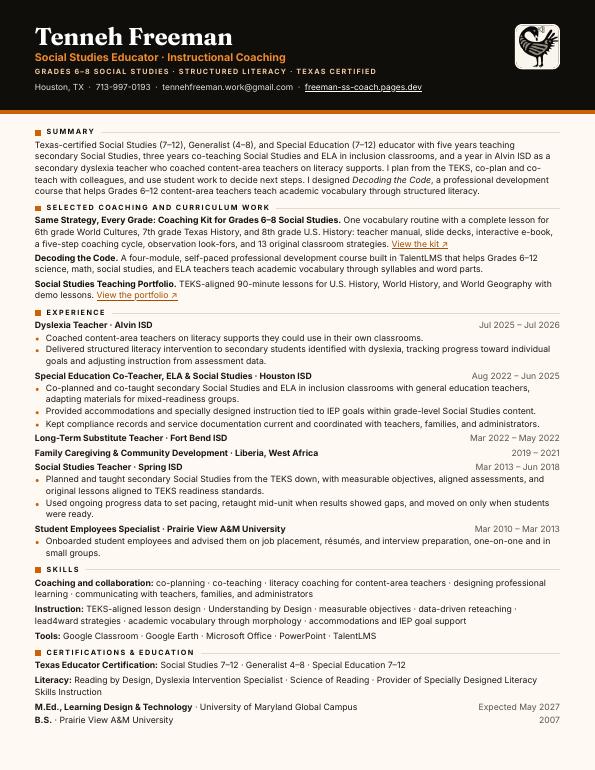
Résumé & cover letter
Applying for Instructional Coach, Social Studies, at Alvin Junior High (Job ID 10199). Texas certified in Social Studies 7–12, Special Education 7–12, and Generalist 4–8. Available immediately.
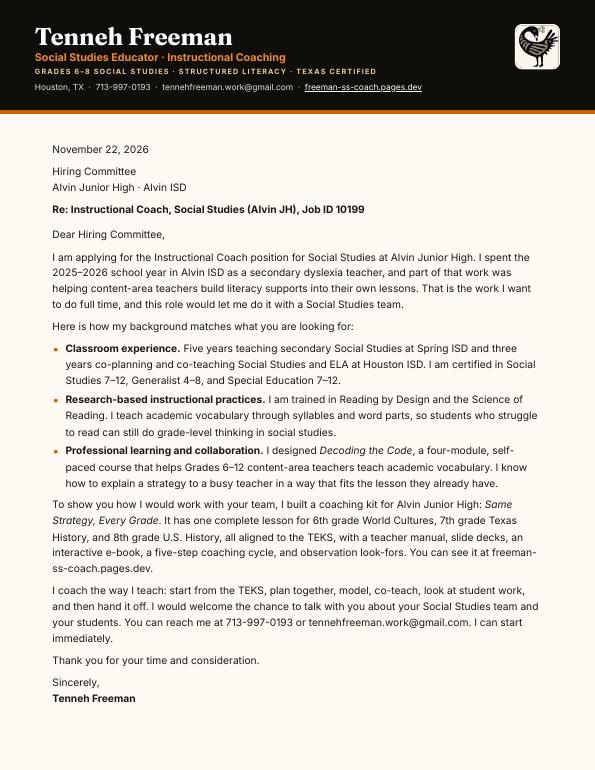
Cover letter
Why I want to coach Social Studies at Alvin Junior High, and what I bring to your teachers.
Download cover letter (PDF)Available now